App · Travel
Sylt Autozüge
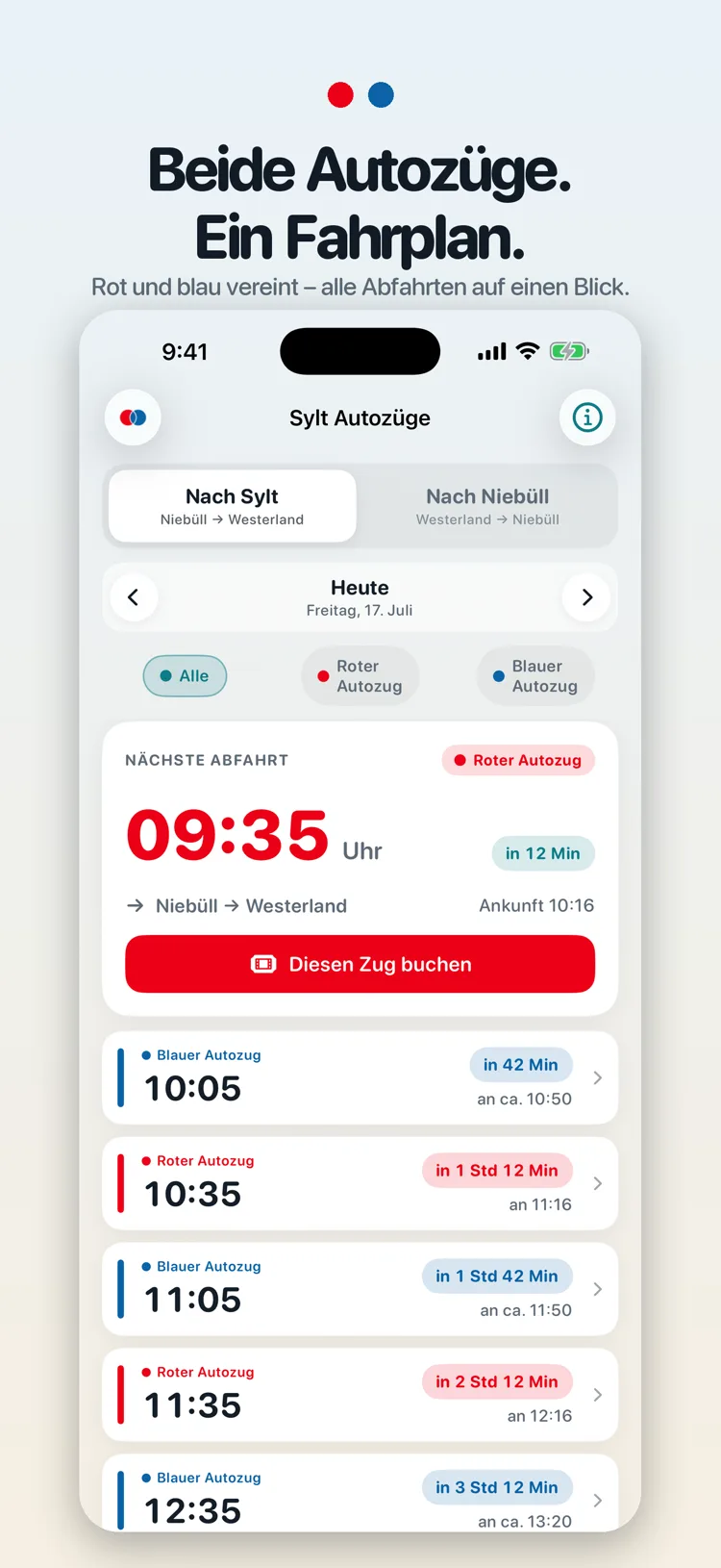
The red DB Sylt Shuttle and the blue RDC Autozug in one list — sorted chronologically, with a countdown to check-in and reported delays.
- Free
- Both operators in one list
- Countdown to check-in
- Delays
- Works offline
App · Travel
The red DB Sylt Shuttle and the blue RDC Autozug in one list — sorted chronologically, with a countdown to check-in and reported delays.
On this page
There's no road between the mainland and Sylt. If you want to bring your car to the island, it has to be loaded onto a train over the Hindenburgdamm — and two different operators run trains there, each with its own timetable. This app overlays both and shows you which train goes next.
Check-in times for both car trains between Niebüll and Westerland in the 2026 summer timetable (red train until November 1, blue train until November 8). All times are check-in deadlines: the latest time your car has to be at the loading ramp.
| Train | Direction | First to last check-in | Departures per day | Time to arrival |
|---|---|---|---|---|
| Red car train (DB Sylt Shuttle) | Niebüll → Sylt | 4:05 AM* to 9:05 PM | 18 | 41 min |
| Red car train (DB Sylt Shuttle) | Sylt → Niebüll | 4:55 AM to 8:55 PM | 18 | 50 min |
| Blue car train (RDC Autozug Sylt) | Niebüll → Sylt | 4:30 AM* to 7:05 PM | 11–12 | 45–50 min |
| Blue car train (RDC Autozug Sylt) | Sylt → Niebüll | 5:55 AM to 6:55 PM | 11 | 50 min |
* The 4:05 AM (red) and 4:30 AM (blue) departures run Monday to Friday only. In the winter timetable the red train runs 14 times a day in each direction, starting at 5:25 AM toward Niebüll. For the blue train, the winter timetable applies from November 9, with the last check-in at 5:35 PM from Niebüll and 5:55 PM from Westerland. The app shows the exact times for any day, including reported delays.
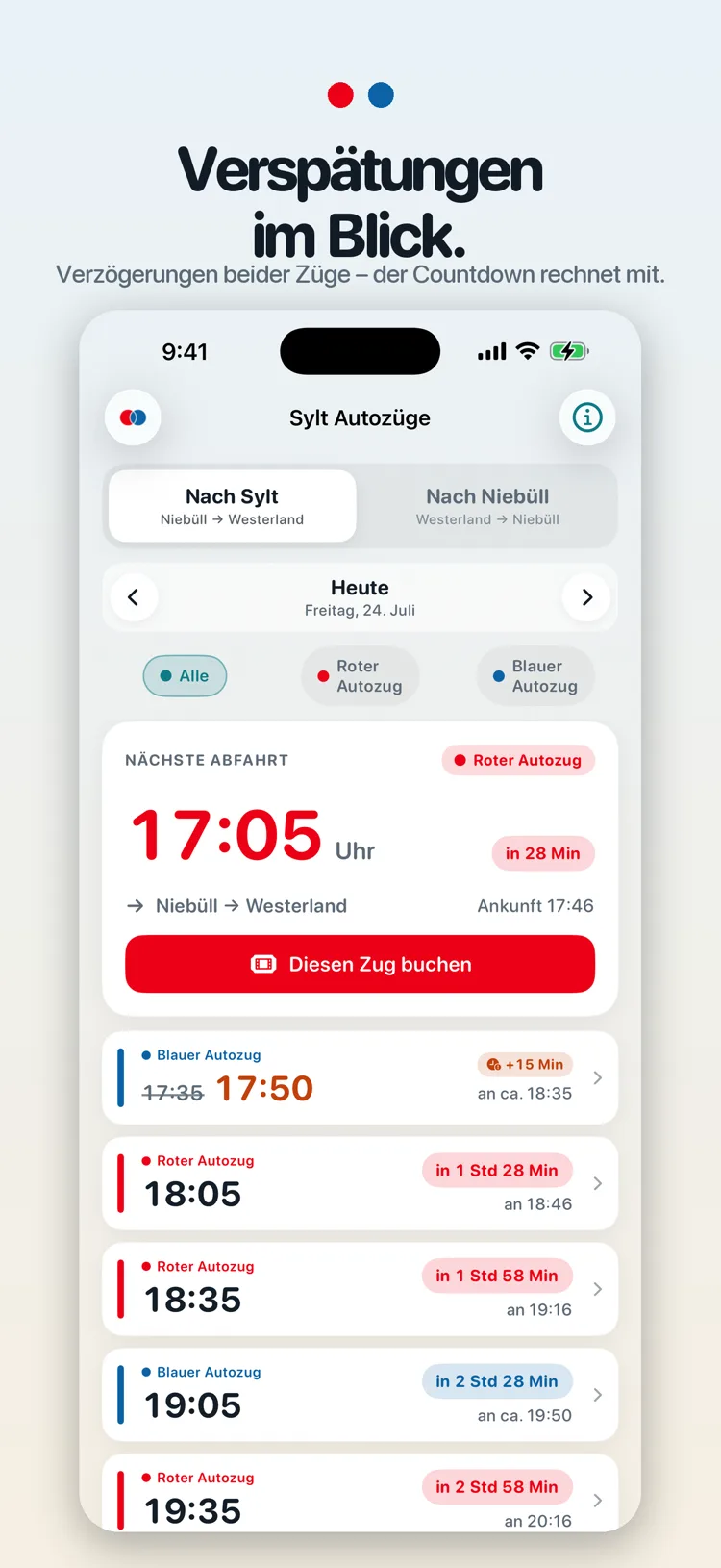
Two operators run between Niebüll and Westerland: the red DB Sylt Shuttle and the blue RDC Autozug Sylt. The app overlays both timetables and shows them as one chronological list — the color tells you at a glance which one it is.
The next reachable departure sits right at the top, with a countdown. That answers exactly the question you have on the A7 heading north: not "when does the DB train leave", but which of the two trains is the next one I can still catch.
Every detail of both timetables is already built in: summer and winter schedules with their different validity periods, departures only Monday through Friday, departures only on weekends, holiday rules, and the three departures without motorcycle transport. You choose the direction and date — the app shows what actually runs that day.
Reported delays from both operators feed into the same list too. Instead of keeping two websites open side by side, one glance at your phone is enough — even without signal, because the timetable is built into the app.
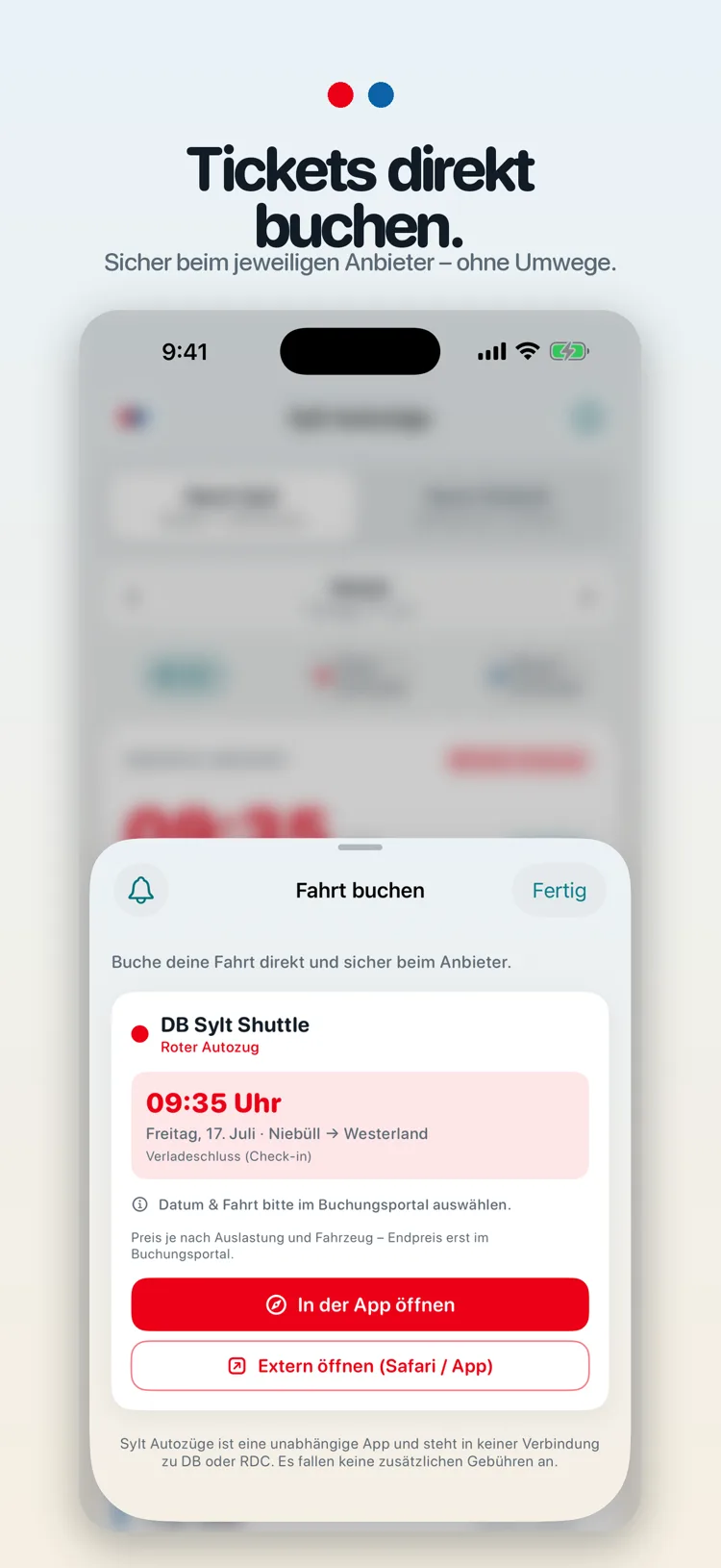
All published times are check-in deadlines (loading close) — the latest time your car needs to be at the loading point. The train only departs after that. The crossing over the Hindenburgdamm then takes about 35 minutes.
If you read this as the departure time and cut it close, you'll find loading already closed and end up waiting for the next train. That's exactly why the app shows the check-in deadline throughout, explains what it means in several places — and offers a reminder feature.
This trips a lot of people up: "Sylt Shuttle" and "Autozug Sylt" aren't two names for the same thing. The Sylt Shuttle is DB Fernverkehr AG's red train, the Autozug Sylt is RDC Autozug Sylt GmbH's blue train. They're independent companies with separate tickets — a ticket for one isn't valid on the other.
Another common misunderstanding: there's no car ferry to Sylt from Niebüll. A car ferry runs only from Rømø in Denmark. The German connection is the train, and only the train.
Open the app — that's it. No onboarding, no registration, no permission prompts. The next departure appears right away, front and center: operator, time, countdown ("in 13 min"), route and arrival time.
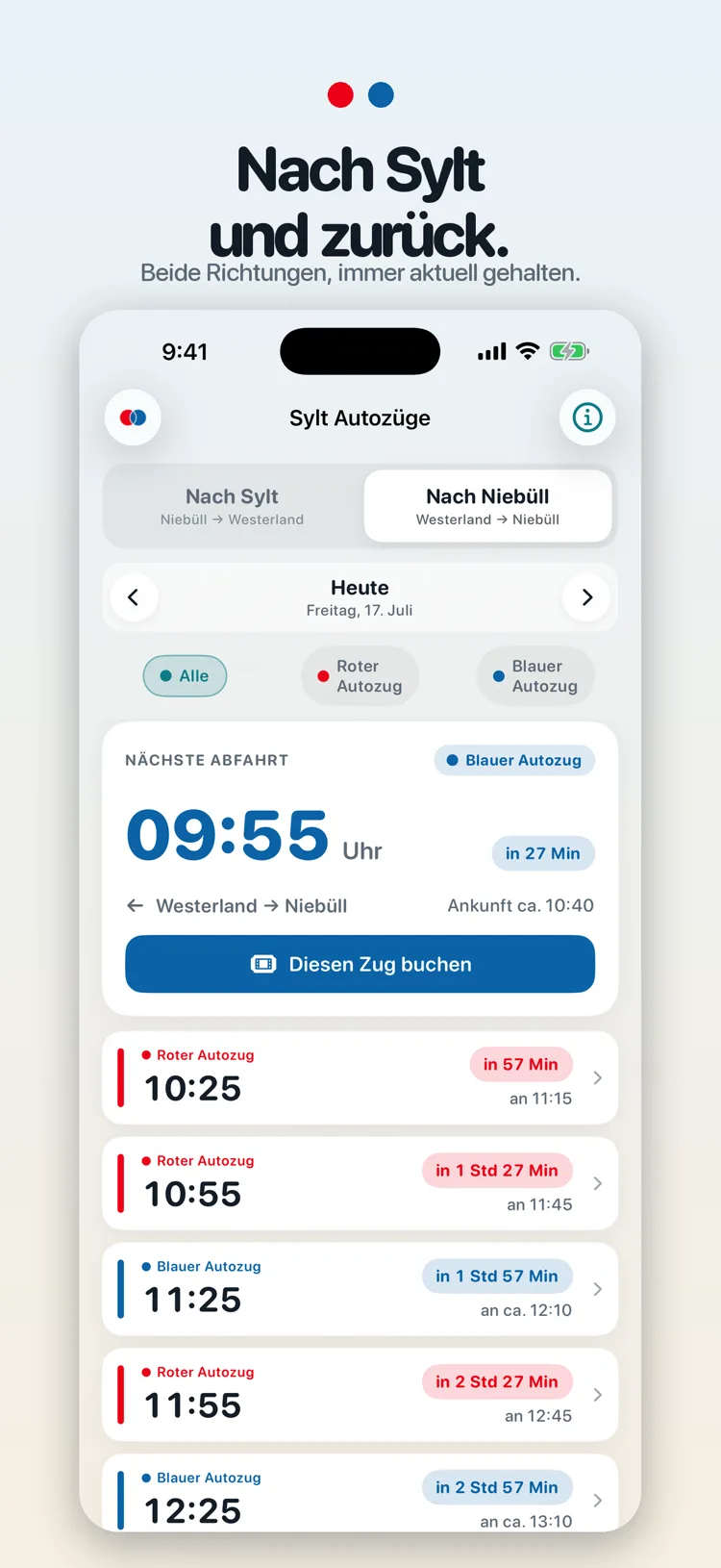
Switch direction. Two fields sit at the top: To Sylt (Niebüll → Westerland) and To Niebüll (Westerland → Niebüll). "To Sylt" is the default. If you prefer, you can let the app choose the direction automatically based on your location — more on that below.
Pick a different day. Below that is the date bar with arrows for the next and previous day. Tapping the date opens a calendar that reaches twelve months forward and twelve months back. If needed, you can filter to just red or just blue.
Tap a train and book. Tapping opens a sheet with operator, time, route and the explicit label "Check-in deadline". From there you continue to the relevant operator's booking portal — either in the built-in browser or externally.
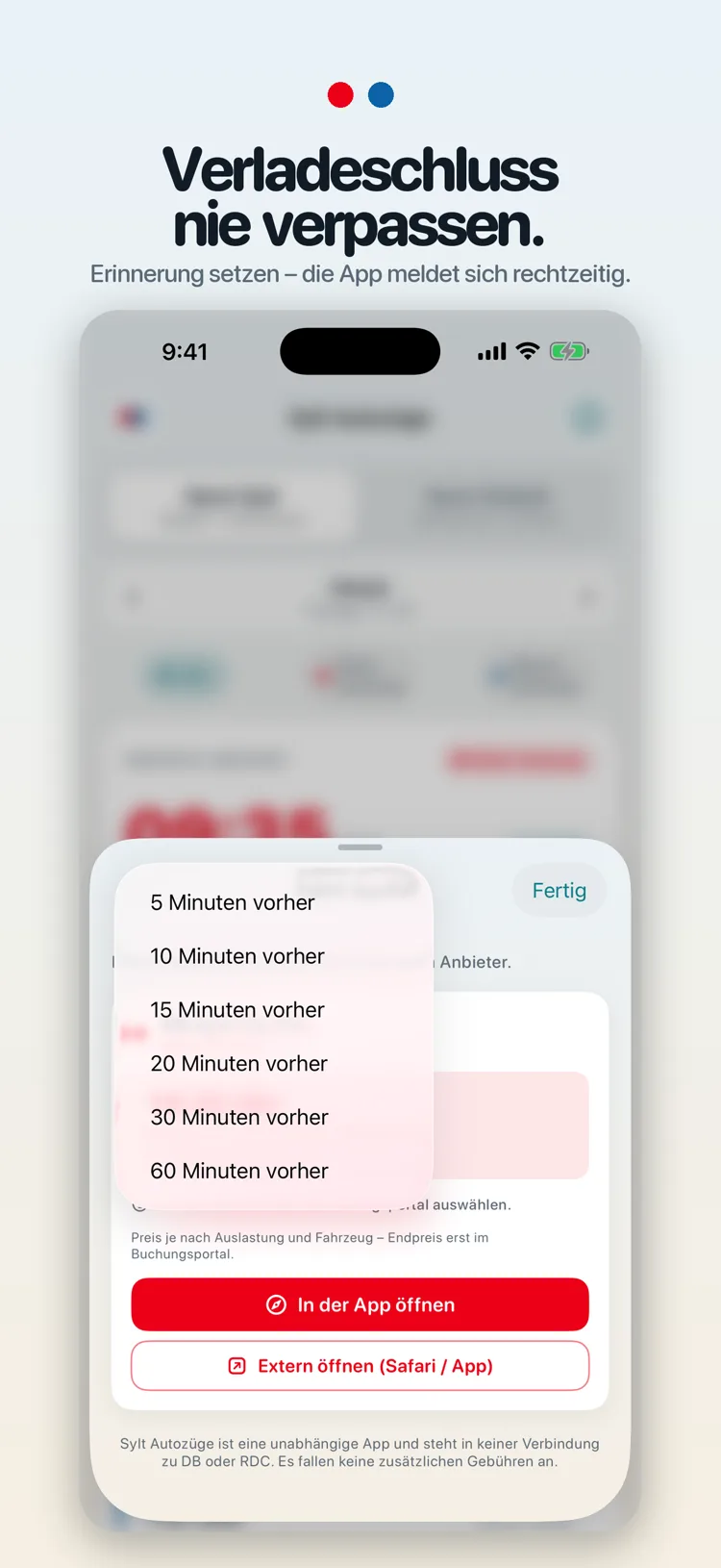
Set a reminder. The same sheet has a "Remind me" button with six lead times: 5, 10, 15, 20, 30 or 60 minutes before check-in. Only times still in the future are offered. The reminder runs locally on the device, with no server involved.
Calculated from check-in to arrival:
| Train | Direction | Duration |
|---|---|---|
| Red DB Sylt Shuttle | to Sylt | 41 min |
| Red DB Sylt Shuttle | to Niebüll | 50 min |
| Blue RDC Autozug Sylt | to Sylt | 45–50 min |
| Blue RDC Autozug Sylt | to Niebüll | 50 min |
The red train's arrival times are stored exactly; the blue train's are an approximation — which is why the app always shows "approx." in front of them.
Summer operating hours: the red train runs toward Sylt from 4:05 AM to 9:05 PM and back from 4:55 AM to 8:55 PM. The blue train runs toward Sylt from 4:30 AM to 7:05 PM and back from 5:55 AM to 6:55 PM. In winter, the red train's first departure toward Niebüll starts later, at 5:25 AM.
The blue train runs in winter too. RDC's winter timetable applies from November 9, 2026; some evening departures are dropped, and the last departure is at 5:35 PM from Niebüll and 5:55 PM from Westerland. RDC has not yet published the individual winter times — as soon as they are available, they will be added to the app.
One detail that's easy to miss: holidays count as weekends. Departures marked "Sat/Sun/Holiday" also run on public holidays — and departures marked "Mon–Fri" don't. The app knows the holidays and factors them in automatically.
Three departures toward Sylt don't carry motorcycles, all on the red train and the same in both the summer and winter timetable: 4:05 AM (Monday through Friday), 5:05 AM (daily) and 5:35 AM (Saturdays, Sundays and holidays). The app flags these departures as "No motorcycle transport".
Since version 1.3, the app shows reported delays for both operators. When there's a delay, the scheduled time is struck through and the actual time is shown next to it in orange, along with a badge like "+20 min". Cancellations appear as "Canceled". Importantly: the countdown and arrival time both factor in the delay — otherwise the app would send someone off at the wrong time.
Because there's no shared source, the app pulls the data from two separate systems. That explains a difference that would otherwise look like a bug: delays for the red train usually only appear within the half hour before departure, while the blue train's show up much earlier. The blue operator maintains its delays for the whole day and in rough increments, while DB only delivers real-time data shortly before departure.
If no report comes in, nothing is shown. A departure without a note isn't automatically on time.
The operators report their own delays, usually in rough increments. So it's a reported status, not live tracking of the train — please don't plan down to the minute.
One detail with real consequences: if a train is delayed enough to actually depart after a later-scheduled one, it stays at its original position in the list. The large highlighted entry, though, correctly jumps to whichever train genuinely goes first. That's intentional — it means you'll still find the train where you expect it in the list.
No booking inside the app. Tickets aren't purchased here — the app only forwards you to the relevant operator's booking system, where their own terms and privacy rules apply.
No prices and no price comparison. What the crossing costs depends on vehicle size, demand and fare. A displayed number would be misleading, so the app simply says: final price only in the booking portal.
No occupancy display and no wait times. The app has no way of knowing how long the line of cars at loading is. And the data sources simply don't provide occupancy for the car train — that figure refers to seats in passenger trains and stays empty for car trains.
No notification for delays. Reminders are time-based and use the scheduled time. That's intentional: if you set a reminder 45 minutes ahead, you still want to leave on time — and delays often resolve themselves anyway.
There are also no widgets, no Shortcuts, no sharing or export function, no map and no route planning to the loading station. The app runs only on iPhone with iOS 17 or later, in portrait orientation only, and only in German. It shows only the two car trains — no passenger trains, no ferries, no flights.
That's the core of it, and the reason this app exists. Each operator only shows its own trains — understandable, but not enough to answer "when does the next one go". The app sorts red and blue chronologically together and marks them by color throughout.
The app deliberately shows the check-in time and explains what it means in several places, instead of just stating a number with no context.
It shows when each timetable was last updated and up to when it's confirmed. If a delay source is missing, that's stated rather than hidden. And a missing report is never shown as "on time".
Open it and read it off — at around 1.3 MB, the app downloads in seconds and starts without any setup.
The app is completely free. Every feature described here is fully usable with no restrictions. Costs are only ever incurred with the relevant operator, for the train ticket itself.
Your location is only evaluated on the device, to work out whether you're on the island or the mainland — it's never stored or transmitted. Reminders and settings stay on the device too.
The timetable file download and the delay lookup with both operators go out to the internet; no personal, device or travel data is transmitted in the process. The delay lookup can be turned off in the app's info section.
The full explanation is in the Privacy Policy.
This is an independent app and not an official app of DB Fernverkehr AG or RDC Autozug Sylt GmbH. All trademarks belong to their respective owners.
Times = check-in deadline (loading close). All information provided without guarantee. Only the information from the relevant transport operator is binding.
The app was created on the initiative of Philipp Rolle.
Questions & Answers
It's the check-in deadline — the latest time your car needs to be at loading. The train departs a few minutes later, and the crossing over the causeway then takes about 35 minutes. This is the most common misunderstanding on this route, which is why the app labels the time explicitly.
Both are common; the terms of the relevant operator are what count. The app doesn't book anything itself — it takes you to the booking portal for the red or blue train, where you choose your date and departure.
That depends on vehicle size, demand and fare, which is why the app deliberately doesn't show prices. You'll only see the final price in the operator's booking portal.
The crossing itself over the Hindenburgdamm takes about 35 minutes. From check-in to arrival in Westerland, the app calculates 41 minutes for the red train and 45 to 50 minutes for the blue train. In the other direction, to Niebüll, both trains take 50 minutes.
The two operators publish their timetables separately: DB for the red car train at syltshuttle.de, RDC for the blue car train at autozug-sylt.de. The Sylt Autozüge app combines both in one list. The table “Sylt car train timetable at a glance” at the top of this page gives an overview of check-in times, departures per day and travel time.
Because the data is different: the red train's arrival times are stored exactly, the blue train's only as an approximation. The app flags this instead of pretending to a precision that doesn't exist.
No. If no report comes in, nothing is shown. A departure without a note isn't automatically on time. Delays for the red train usually only appear within the half hour before departure anyway, while the blue train's show up earlier — that's down to the different data sources.
Because that information isn't available. The railway's occupancy data refers to seats in passenger trains and stays permanently empty for car trains — there's no reservation for a car train, just drive-up traffic. The blue operator only shows occupancy within its own booking shop.
No. Reminders are time-based and use the scheduled time; they don't shift if there's a delay. That's intentional — if you set a reminder 45 minutes ahead, you still want to leave on time, and delays often resolve themselves anyway.
Yes, on most departures. Three departures toward Sylt don't carry motorcycles, all on the red train: 4:05 AM Monday through Friday, 5:05 AM daily, and 5:35 AM on weekends and holidays. The app flags these departures.
Yes. The blue RDC Autozug Sylt also runs in winter, on its winter timetable from November 9, 2026: some evening departures are dropped, and the last departure is at 5:35 PM from Niebüll and 5:55 PM from Westerland. RDC has not yet published the individual winter times, so the app cannot show them yet. The red train also runs year-round, with a slightly shorter timetable in winter.
Yes, for everything essential. The complete timetable is included in the app — departures, countdowns, reminders and the calendar all work normally offline. Only the delay display and the automatic timetable update need an internet connection.
Only if you turn it on — the feature is off by default. When enabled, the app picks the right direction on opening: "To Niebüll" on Sylt, "To Sylt" on the mainland. The decision happens entirely on the device; your location is never stored or transmitted. Your own manual selection always takes priority.
No. This is an independent app and not an official app of DB Fernverkehr AG or RDC Autozug Sylt GmbH. It brings together the publicly published timetables of both operators.
No, they're two different companies. The Sylt Shuttle is DB's red train, the Autozug Sylt is RDC's blue train. They have separate timetables, separate prices and separate tickets — a ticket for one isn't valid on the other.
Not from Niebüll. A car ferry runs only from Rømø in Denmark to List on Sylt. The only German connection for cars is the train over the Hindenburgdamm.
The data is automatically checked against both operators' timetable pages every week, and the app downloads a newer version on launch if one is available. In the info section, you can see for each operator separately when the timetable last changed and up to which date it's confirmed. For later days, the app still shows the times but flags them as unverified.
The app is built for iPhone, requiring iOS 17 and portrait orientation only. On iPad it runs in iPhone compatibility mode without its own layout. There's no version for Apple Watch, Mac or Android.