Home·Apps·Ochely
In steel-tip darts, someone keeps score and does the math for everyone. This darts scoreboard takes that over: you tap every dart, it works out the remaining score, bust and checkout suggestion — and remembers, at the end, just how good you really were.
Throw, tap, keep going
You tap in every dart individually — first single, double or triple, then the number. After three darts, the app switches to the next player on its own. No math in your head anymore: the remaining score sits large on the screen, turning your iPhone into a darts scoreboard everyone at the board can read.
The app knows the rules by heart. It recognizes a bust and resets the score — including the two cases that regularly cause arguments at the board: a remaining score of 1 on double out, and hitting the wrong field on the way to zero.
Whenever a remaining score can be checked out, the checkout route appears right underneath it. For 96, that's triple 20 and double 18 — the app has 162 routes stored for every remaining score from 2 to 170. Beginners no longer have to throw blind, and experienced players skip the mental math.
And since every throw gets tapped in anyway, the stats you'd otherwise have to keep a table for appear on their own: 3-dart average, first 9, double rate and highest finish, per player and over time. It's all there by itself after the last leg.
If you're not at the same board, one player opens a room and shares the code: up to four players tap their own turns on their own device, and everyone sees the same score.
How it works
1
Open it and start playing
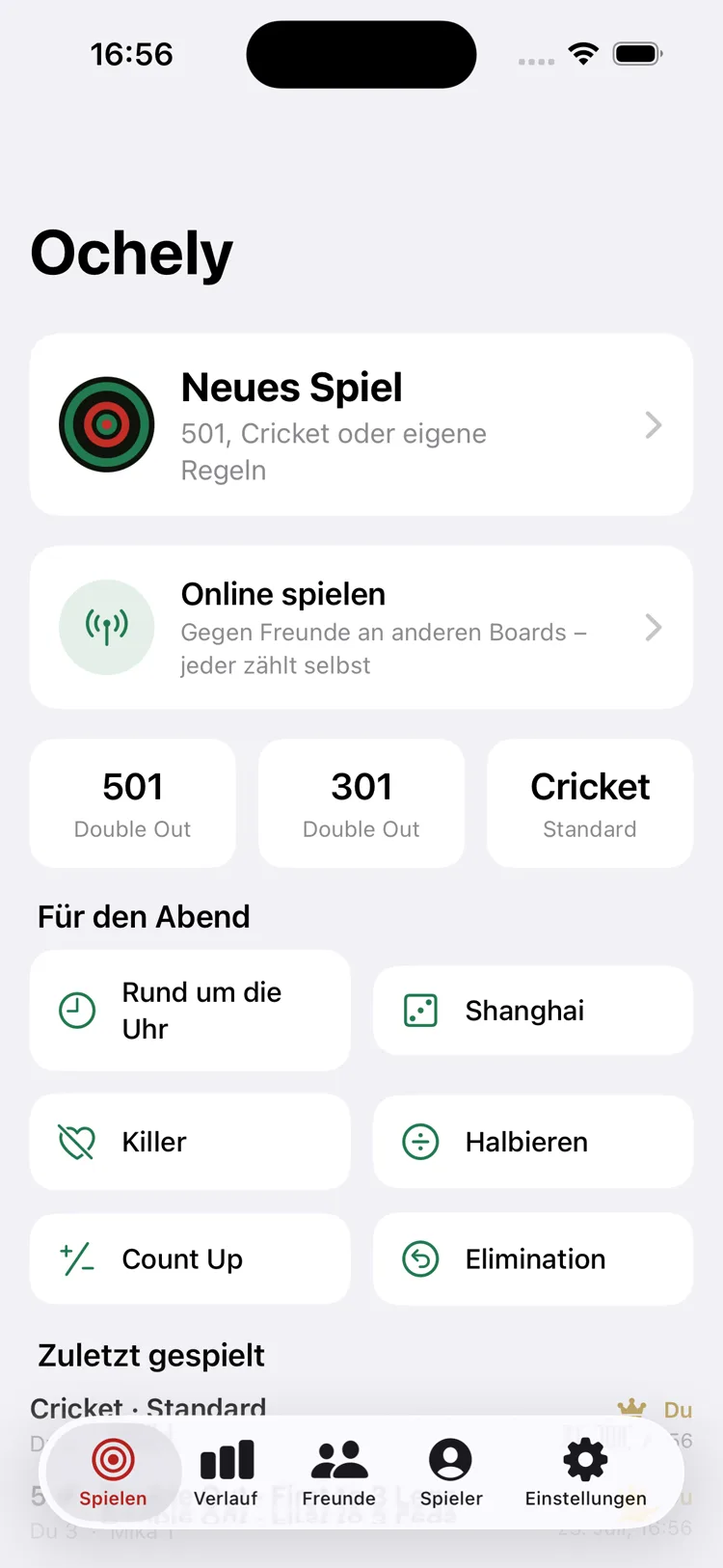
There's no onboarding, no sign-in screen and no prompt on first launch. You land straight on "Play" — with three quick-start buttons for 501 Double Out, 301 Double Out and Cricket.
Below that sits "For the Evening" with the six party games, plus the entry point into online play for when you're not at the same board.
2
Rules only when you need them
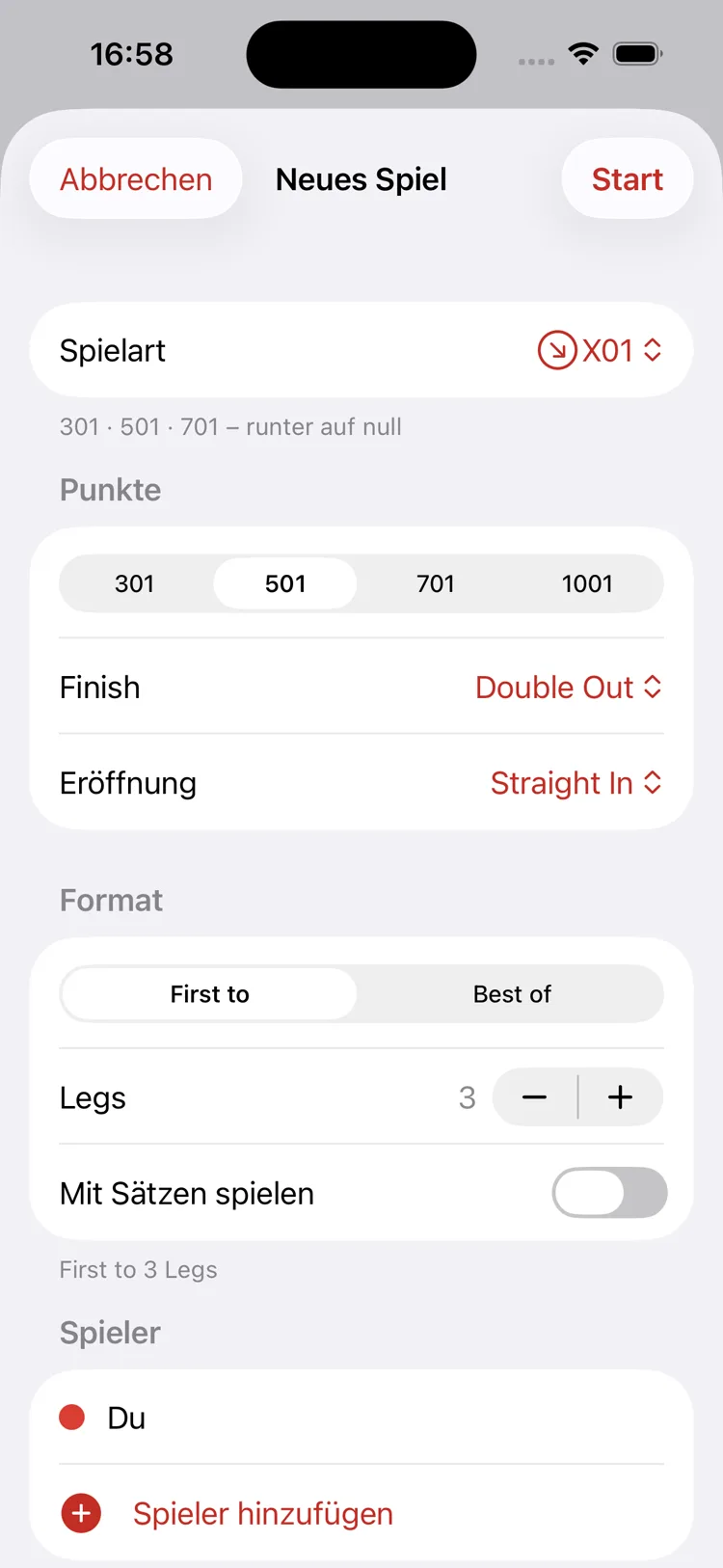
If you want more than 501, everything is set here: starting score of 301, 501, 701 or 1001, finish as double, master or single out, opening with straight or double in, plus format, number of legs and sets if you want them.
Below the format, what it means is always spelled out in plain text — for example First to 3 Legs. Below that you enter the players, up to eight, and save them as a profile if you want.
3
Tap every dart individually
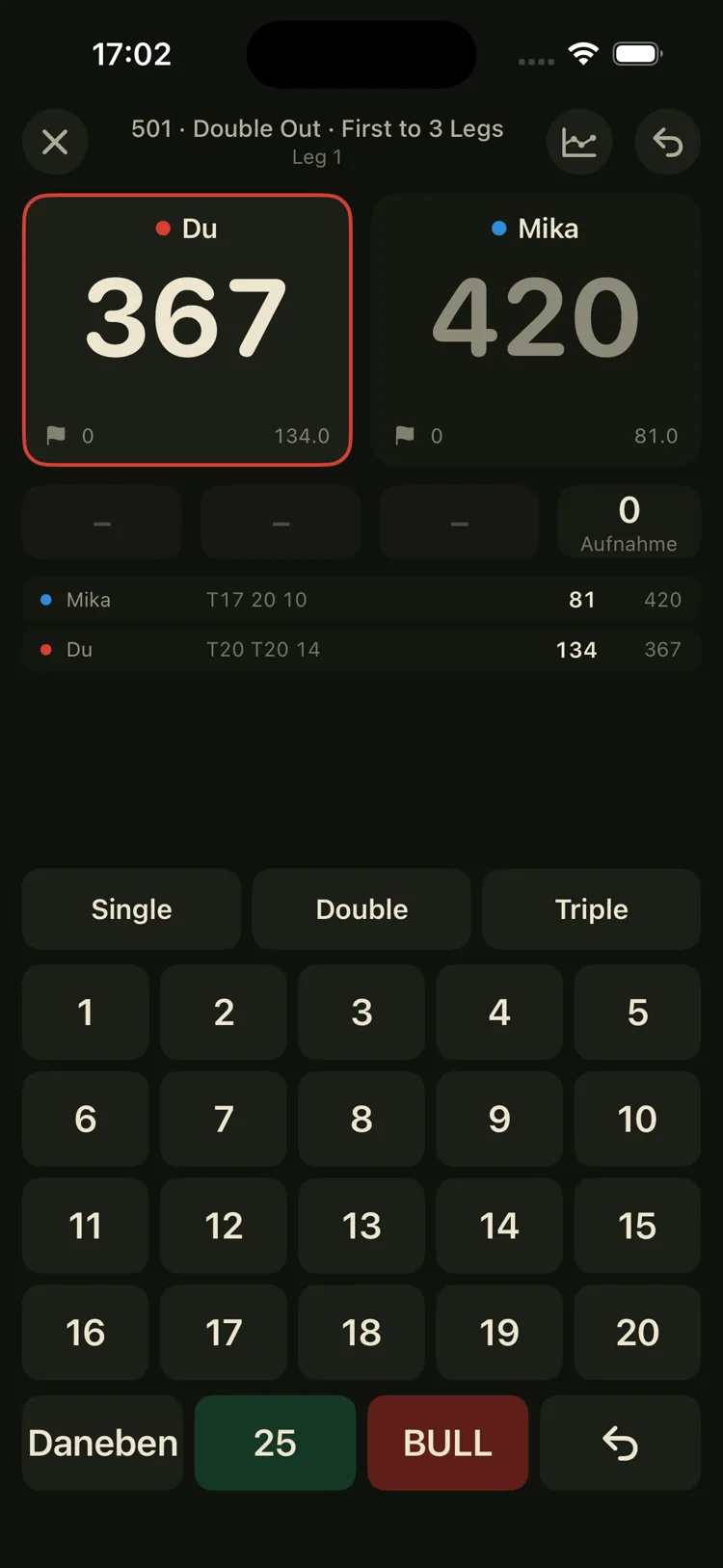
The keypad sits at the bottom: one row for single, double and triple, below it the numbers 1 to 20, plus Miss, 25 and Bull. For triple 20 you tap "Triple" first, then "20". After three darts, the app switches to the next player on its own.
Both players' remaining scores sit at the top, with the active one outlined in color. The remaining score gets deducted, and the app recognizes busts on its own — including a remaining score of 1 and the wrong field on the way to zero. Every throw can be undone individually.
4
The summary appears on its own
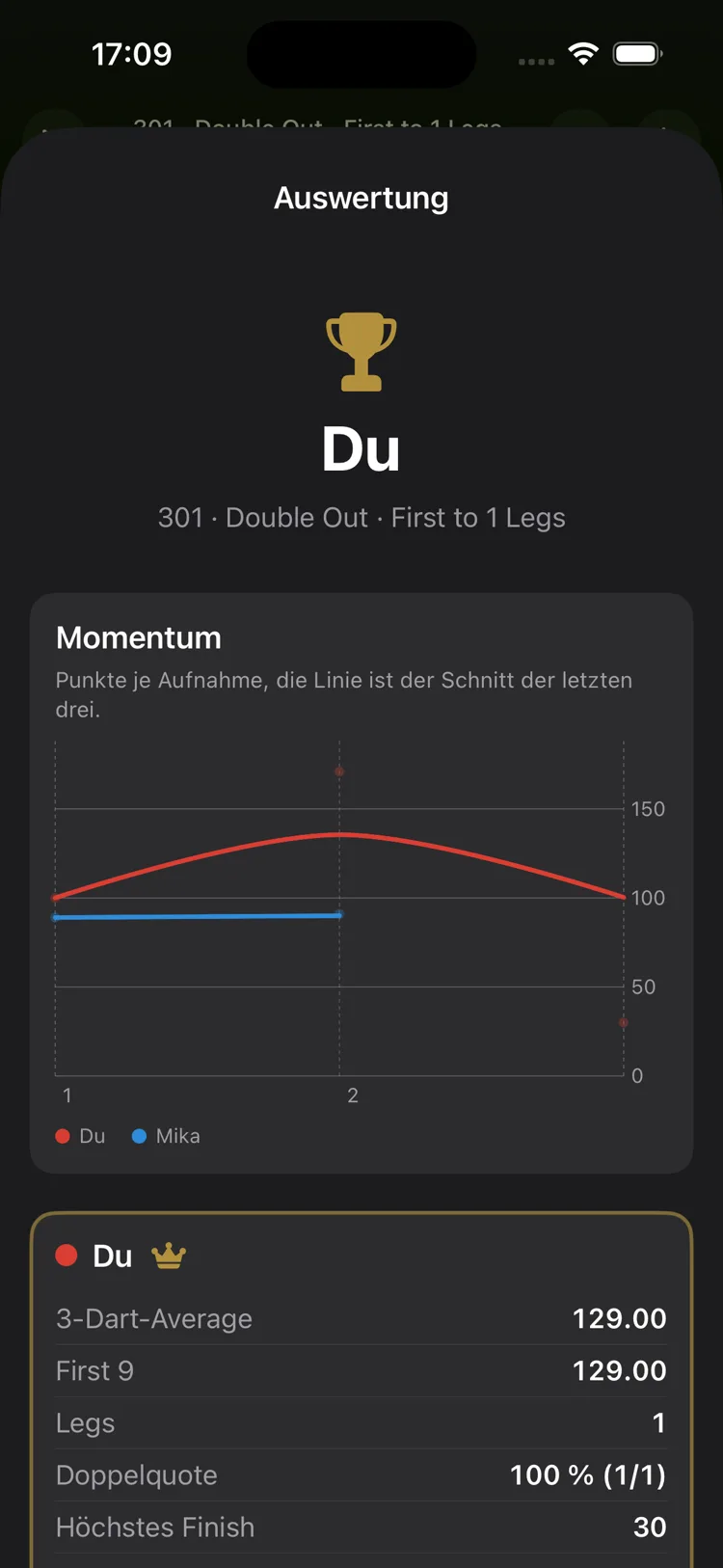
No save button. Whoever reaches zero wins the leg, and after the last leg, the summary opens on its own — everything's already saved by then.
Up top, the momentum chart with points per turn; below that, a card per player with 3-dart average, first 9, legs, double rate and highest finish.
5
Over weeks, it becomes a curve
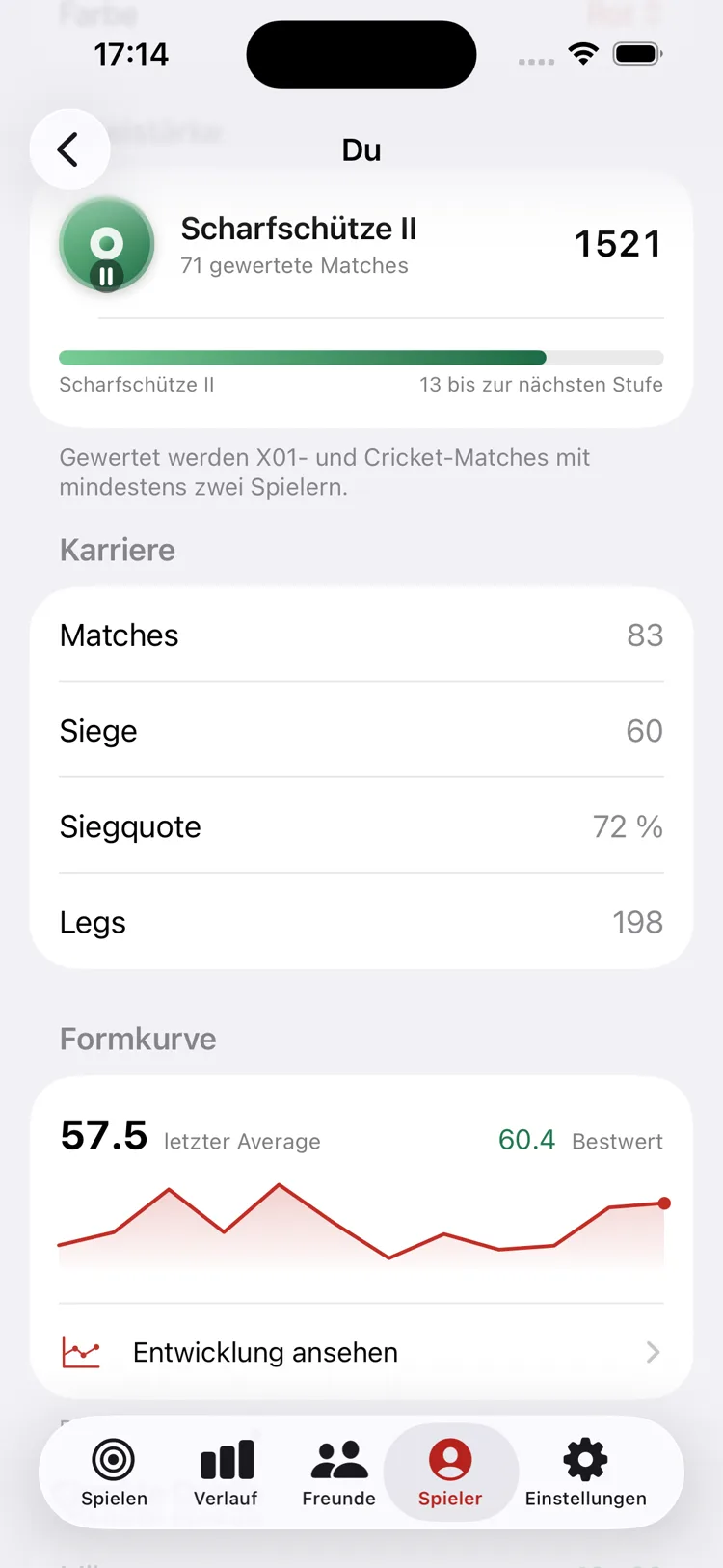
The player profile shows your rank with its skill rating value, your career with matches, wins, win rate and legs — and the form curve with your latest average and your personal best.
The bar shows how far it is to the next tier. Below that it states plainly what feeds into the rating: X01 and cricket matches with at least two players.
The names and numbers in these images come from test matches and are not real player data.
The rules the app knows
Double out, master out, single out
With double out, the last dart has to be a double. The bullseye counts for this — it's double 25 and therefore a double. The outer bull ring, though, does not. Master out also allows a triple; there's no triple on the bull. With single out, any field except a miss ends the leg.
Bust — three cases, each one enough on its own
- The remaining score would drop below zero.
- The remaining score would be exactly 1 — invalid on double out and master out, because you can't finish 1 with a double.
- The remaining score would be zero, but the dart hit the wrong field.
In all three cases, the score jumps back to what it was at the start of the turn, and the turn ends immediately — even if it was the first dart. Points from that turn don't count.
First to and best of
First to 3 means three wins. Best of 5 the app converts to three wins needed, best of 6 to four. The opening throw rotates leg by leg.
The checkout route table: which way for which score
The app has 162 checkout routes stored for every remaining score from 2 to 170. Whenever a route is available, it's shown directly under the remaining score. The best-known ones:
| Remaining Score | Route |
|---|
| 170 — the highest possible finish | T20 · T20 · Bull |
| 167 | T20 · T19 · Bull |
| 160 | T20 · T20 · D20 |
| 140 | T20 · T20 · D10 |
| 110 | T20 · Bull (two darts) |
| 100 | T20 · D20 |
| 96 | T20 · D18 |
| 81 | T19 · D12 |
| 40 | D20 |
| 36 | D18 |
| 32 | D16 |
Bogey numbers: seven scores with no route
Seven numbers can't be checked out on a double with three darts — there simply is no combination for them. They're called bogey numbers:
159 · 162 · 163 · 165 · 166 · 168 · 169
If one of these remaining scores is showing, the app displays no suggestion — not because it can't find one, but because none exists. Whoever lands there first has to bring the score into a reachable range with the next throw.
With master out and single out, the standard table doesn't apply; there, the app works out the route fresh every time and favors the common doubles in the order 20, 16, 18, 12, 10, 8, 14, 6, 4, 2.
What's simply not possible with three darts
The app also checks when you enter a whole turn's total: it rejects ten totals because they're impossible with three darts — 179, 178, 176, 175, 173, 172, 169, 166, 163 and 159. The maximum stays 180.
Cricket
Play targets seven numbers: 20, 19, 18, 17, 16, 15 and bull. Three hits — called marks — close a number; a triple does that in one throw but scores no points that way. The outer bull ring counts as one mark, the bullseye as two.
In standard cricket, extra marks earn the thrower points — the number times the count — but only as long as at least one opponent still has that number open. In cut-throat, it's the other way around: all opponents get the points added to their score, and whoever has the fewest wins at the end. In the no-score variant, closing out is all that counts. The bull is worth 25 points per mark.
Six game modes for the evening
- Round the Clock — 1 to 20 in order, with the bull as 21 if you like. Aim for a target and optionally require a double or triple only. No math at all, which makes it the best starting point for people who've never thrown before.
- Shanghai — seven rounds, and in round n, only the number n counts. Whoever hits single, double and triple of the same number in one turn wins on the spot.
- Killer — three lives, everyone is randomly assigned a number, and only doubles count at all. Hitting your own double first makes you a killer; after that, you take lives with other players' doubles.
- Halve It — target sequence 20, 16, double 7, 14, triple 10, 17, bull. Whoever misses a round entirely has their score halved.
- Count Up — eight rounds of simply racking up points. Theoretical maximum: 1440.
- Elimination — from 301 down to exactly zero, with no double requirement. Whoever hits exactly an opponent's score sends them back to the starting value.
What the numbers mean at the end — and how they're worked out
| Metric | Formula |
|---|
| 3-Dart Average | points ÷ darts × 3 |
| First 9 | the same, but only across the first three turns of a leg |
| Double Rate | checkouts hit ÷ darts thrown at a finish × 100 |
| MPR (Cricket) | marks ÷ rounds |
For the double rate, every dart counts as an attempt if it's thrown at a remaining score that could be finished with one dart — not just the final one.
The scoring classes are mutually exclusive: 180 means exactly 180, 140+ means 140 to 179, and 100+ means 100 to 139. A maximum score doesn't also count as 140+. "Highest finish" is the remaining score at the start of the turn in which you checked out; "best leg darts" counts only legs you won.
One detail that often causes surprise: darts from bust turns still count toward the average. They were thrown, after all. That's why your own average sometimes reads lower than it felt.
Skill rating: a score that accounts for losses too
Ochely rates skill using the Elo principle from chess. Everyone starts at 1200, and the range runs from 0 to 2000. There are seven ranks with three tiers each:
| Rank | From |
|---|
| Novice | up to 800 |
| Pub Player | 800 |
| Club Player | 1000 |
| League Player | 1200 |
| Sharpshooter | 1400 |
| Maximum | 1600 |
| Legend | 1800 |
Lose to a much stronger opponent and you barely lose any points — a 400-point gap corresponds to roughly a 91 percent win probability. In your first ten rated matches, the value moves faster so it settles in quickly. From three wins in a row, a bonus applies, and the margin of victory counts too: a shutout win weighs more than a nail-biter — in both directions.
Only X01 and cricket with at least two players are rated; party games never are. To keep the leaderboard from being skewed by rapid tapping, the app checks four things: the match must have lasted at least one minute, darts must actually have been thrown, at least six darts per leg won are required, and an average of at least one and a half seconds per dart. On top of that, at most twelve matches per day count toward the rating. Everything still shows up in your own history — only the public leaderboard is filtered.
When you're not at the same board
For online play, one player opens a room and shares the room code; up to four players join. The difference from a shared scoresheet: everyone taps their own turns on their own device. What gets transmitted isn't the score, but each individual move — every device works out the same score from that. That way, there's no arguing over whose version is right.
The codes are built for reading out over the phone: they don't contain the letters I, L, O or U, because those get mixed up with 1, 0 and V. If someone types them anyway, the app silently converts them.
Online play runs X01 only. Cricket and the six party games are only available on the same device.
What sets this app apart
Built for standing at the board
The match in progress is always dark, regardless of the system setting, and the screen stays on. It's operated with one hand — the other holds the darts.
The rules are solid
Double, master and single out, busts including a remaining score of 1, straight and double in, first to and best of. Everything that usually sparks a debate at the board is clearly settled.
A match in progress is never interrupted
A match that's been started always plays out to the end and gets saved. And your entire history stays visible for good — you pay for what's new, not for access to what you've already played.
Six game modes for the evening
Alongside X01 and cricket, there's Shanghai, Killer, Halve It, Count Up and Elimination — for the round where not everyone throws equally well.
Numbers that tell a story over weeks
Average, double rate, best finish and skill rating grow with every evening. The form curve shows whether it's trending upward.
What it costs
The core features are free: X01 in every variant, "Round the Clock", the core statistics, your complete history, player profiles, friends, leaderboard, skill rating and taking part in online play.
| Ochely Pro | Price |
|---|
| Monthly | €1.99 |
| Yearly | €14.99 |
| One-time | €22.99 |
Pro unlocks the six additional game modes (cricket, Shanghai, Killer, Halve It, Count Up, Elimination), plus live statistics during a match, the advanced metrics — first 9, best leg darts, 180s, 140+ and 100+, bust turns —, the form curve in your player profile, head-to-head duels against individual players, and opening an online room.
Both subscriptions renew automatically until you cancel; billing runs through your Apple Account, and you can cancel any time in its settings, at least 24 hours before the current period ends. The one-time purchase doesn't renew. There is no free trial. Purchases can be restored and are eligible for Family Sharing. Apple's standard terms of use apply.
If you have an active subscription and also buy the one-time version, the subscription does not end automatically as a result. It has to be canceled in your Apple Account settings, or it keeps running.
What this app is not for
Darts are entered by tapping. The app doesn't count on its own — you enter every throw, and it takes care of the rest: deducting the remaining score, recognizing busts, suggesting a checkout route.
No electronic dartboards. Ochely is built for steel-tip darts on your own board. Electronic dartboards already keep score themselves.
No tournament mode, no league management, no team play. Also no data import or export, and no practice modes like Bob's 27 — the latter are planned for a later update.
The app runs exclusively on iPhone and requires iOS 17. There's no version for iPad, Apple Watch or Mac. The interface is translated into 16 languages — alongside the major darts countries, also Danish, Swedish, Norwegian, Finnish, Polish, Czech, Slovak, Hungarian and Croatian, deliberately.
Ochely is a scoring aid and does not replace official competition scoring. The app reflects common rules but is not an official scoring device. It has no affiliation with darts federations, leagues or dart equipment manufacturers.
Your data stays on your iPhone
Matches, statistics, player profiles and settings live exclusively on your device and disappear if you delete the app.
The details you choose to use leave your device: your profile for the friends list and leaderboard — player name, friend code and the numbers compared there — plus, during online play, the data for the match in progress. Details are in the Privacy Policy.
Apple, iPhone, iOS, iCloud and App Store are trademarks of Apple Inc.