Home Products Apps About Contact Instructions
DE EN

Fall crafts

Chestnut figures

In short

For a chestnut man you need two chestnuts, toothpicks or matchsticks, an acorn cap and an awl or hand drill. Collect the chestnuts fresh, in the Northern Hemisphere from mid-September to mid-October, because fresh chestnuts are much easier to drill. An adult pre-drills the holes; kids put the parts together, glue and draw the faces.

Collecting chestnuts: when and which

These figures are made from horse chestnuts, the shiny brown seeds from spiky green husks that cover the ground under park trees and along avenues in fall. Sweet chestnuts, the edible kind, are smaller, have a pointed tip and a very hairy husk; they work less well.

  • Northern Hemisphere (Europe, North America): mid-September to mid-October, depending on weather and location.
  • Southern Hemisphere (for example Australia, New Zealand, South America): roughly March to April.

Pick chestnuts with a smooth, shiny shell and no holes or soft spots. Collect different sizes for tummies and heads, flatter ones for a hedgehog and rounder ones for an owl. Gather acorns with caps, beechnuts, colorful leaves and straight twigs at the same time; many figures need them.

Tools and materials

Tools

  • An awl or a small hand drill for the holes. A thin nail will do in a pinch.
  • Side cutters or pruning shears to shorten toothpicks and twigs.
  • Craft glue for googly eyes and acorn caps. A hot glue gun is faster but belongs in adult hands.
  • Scissors for leaves, yarn and construction paper.

Materials

  • Toothpicks and matchsticks as joints, arms and legs
  • Googly eyes and a felt-tip pen for faces
  • Acorns and acorn caps, beechnuts, fall leaves, twigs
  • Depending on the figure, pipe cleaners, yarn, construction paper or raffia

When crafting with small children, use toothpicks or matchsticks without heads instead of matches with striking tips.

Pre-drilling holes: how it works

Chestnuts have a hard, smooth shell. Without a pre-drilled hole, a toothpick breaks or slips off. This makes it easier:

  • Drill them fresh. For the first few days after collecting, the inside of a chestnut is still soft. Dried chestnuts turn rock hard.
  • Use a base. Rest the chestnut on a folded cloth or a lump of modeling clay so it does not roll away.
  • Twist, don't push. Turn the awl back and forth with light pressure until it bites. Always drill away from your body and from the hand holding the chestnut.
  • Depth: about a quarter to half an inch, deep enough for the toothpick or matchstick to sit firmly.
  • Glue helps. A drop of glue in the hole keeps the parts in place even when the chestnut dries and shrinks later.

Safety when crafting with kids

  • An adult does the pre-drilling and cuts the toothpicks. Sharp tools slip easily on the smooth shell.
  • Do not leave children under three alone with chestnuts, acorns, beechnuts and googly eyes: small parts can be swallowed.
  • Horse chestnuts are not edible. Eaten raw, they can cause stomach pain and nausea. Handling them for crafts is fine; wash hands afterwards.
  • Halved toothpicks have a pointed end. On the hedgehog the points face out, so for small children use matchsticks without heads instead.

Four chestnut figures step by step

From the easiest to the slightly trickier: chestnut man, hedgehog, owl and fox. All four stand or sit securely on the table.
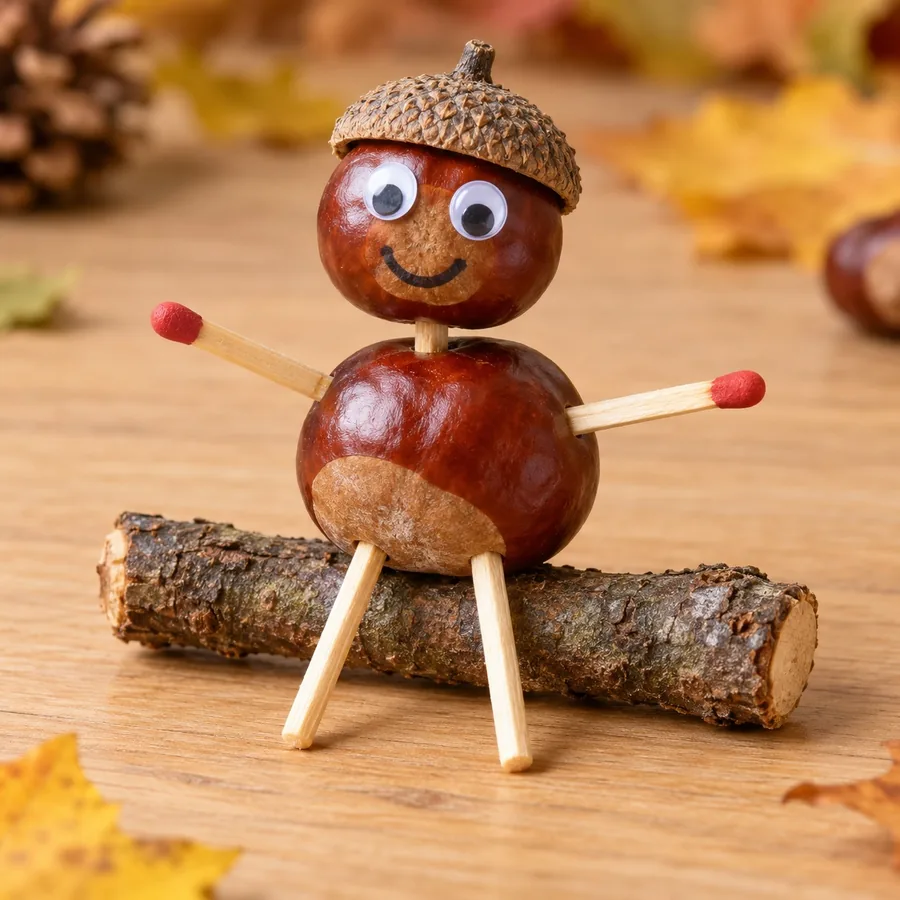
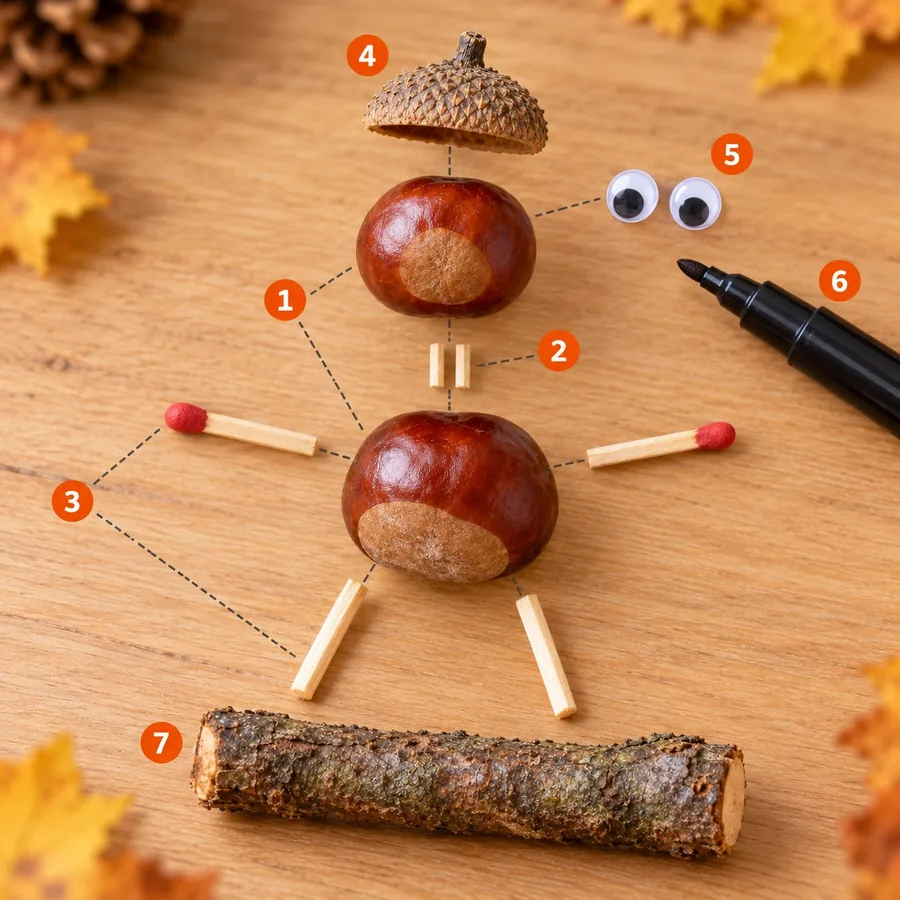
Finished chestnut man on a twig bench Exploded view of the chestnut man with numbered parts: chestnuts, toothpick, matchsticks, acorn cap, googly eyes, felt-tip pen and twig

Left, the finished chestnut man; right, all of its parts pulled apart. The sample images on this page are AI-generated and show what the figure can look like.

Chestnut man with an acorn cap hat, matchstick arms and legs, sitting on a twig

Chestnut man

The original: a chestnut tummy and head, matchstick arms and legs and an acorn cap for a hat, sitting comfortably on a twig bench.

Materials

  • 2 chestnuts (a large one for the tummy, a smaller one for the head)
  • 1 toothpick (cut in half)
  • 4 matchsticks (two with heads for the arms, two without heads for the legs)
  • 1 acorn cap
  • 2 googly eyes
  • 1 felt-tip pen (for the mouth)
  • 1 twig (thumb-thick and straight, about 3 inches, as a bench)

Tools

Awl or hand drill, Craft glue

  1. Use the large chestnut as the tummy and the smaller one as the head.
  2. Drill a hole in the top of the tummy and one in the bottom of the head, and join them with half a toothpick.
  3. Lay the thick twig on the table as a bench and set the tummy on top with plenty of glue.
  4. Drill two holes at the lower front and push in two matchsticks without heads as legs, angled forward and down, so the feet stand on the table in front of the bench. That way the little man sits securely.
  5. Drill a hole on each side for the arms and push in the matchsticks with heads.
  6. Glue the acorn cap onto the head as a hat.
  7. Stick on googly eyes and draw a mouth. Your chestnut man is finished!
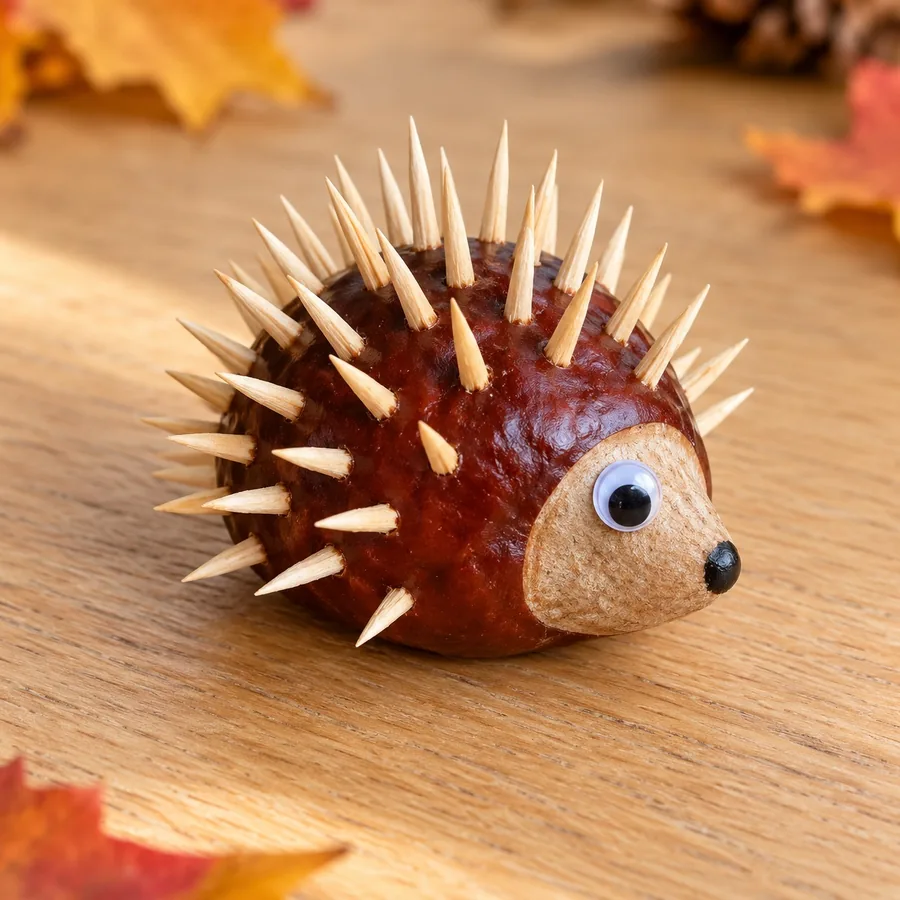
Chestnut hedgehog with prickles made of halved toothpicks and one googly eye

Hedgehog

The classic chestnut animal: one fat chestnut, spiked all over with prickles.

Materials

  • 1 chestnut (a large, rather flat one)
  • 16 toothpicks (cut in half, or matchsticks without heads)
  • 1 googly eye
  • 1 felt-tip pen (for the nose)

Tools

Awl or hand drill, Side cutters or pruning shears, Craft glue

  1. Lay the chestnut down so the pale spot faces sideways. That will be the face.
  2. Cut the toothpicks in half with the side cutters so the prickles are not too long. Each half has one pointed and one blunt end.
  3. Pre-drill rows of holes on the back, about a quarter inch deep and angled toward the back.
  4. Push the toothpick halves into the holes blunt end first, with the points facing out. Leave the front of the head bare.
  5. Glue a googly eye above the pale spot and draw a black nose tip with the felt-tip pen.
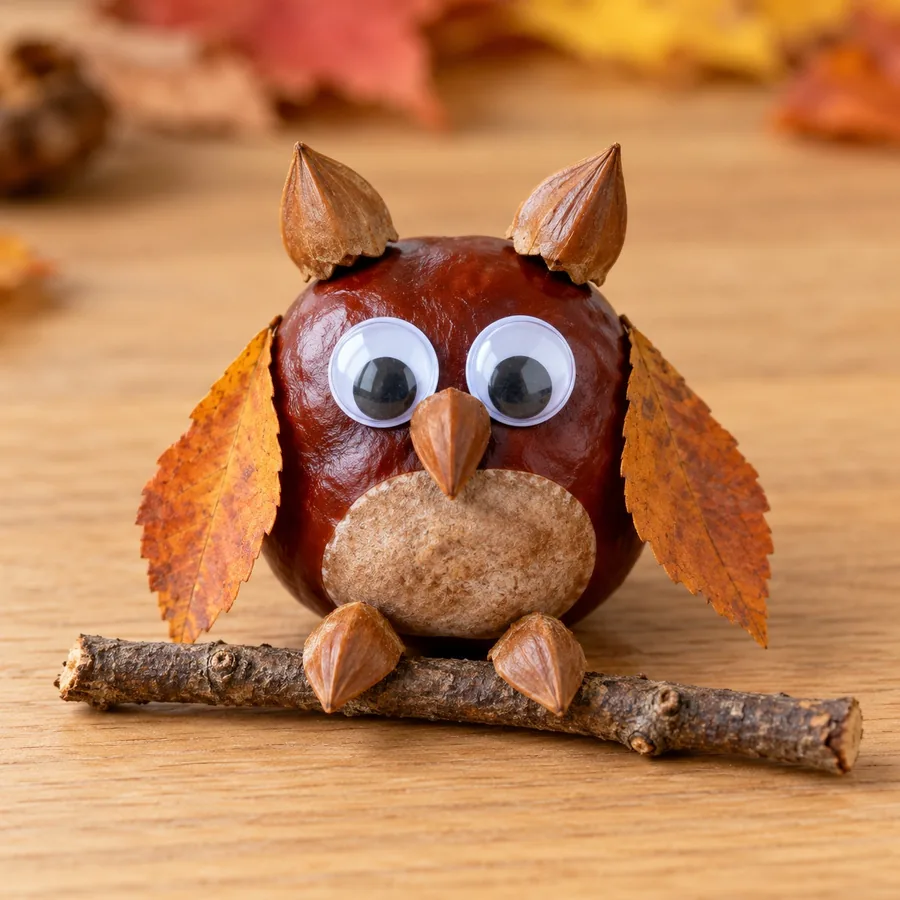
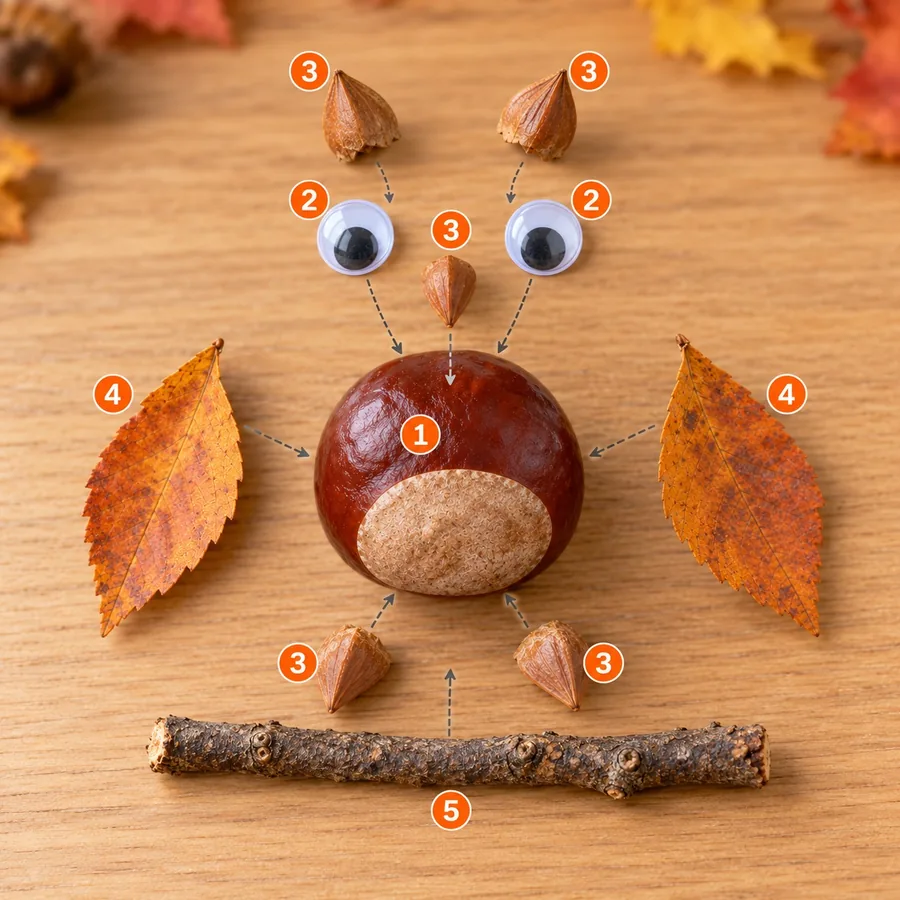
Chestnut owl with big googly eyes, beechnut ears and autumn-leaf wings on a branch

Owl

An owl sitting on the table in front of a branch, with big eyes and leaf wings.

Materials

  • 1 chestnut (a large, round one)
  • 2 googly eyes (as big as possible)
  • 5 beechnuts (two ears, one beak, two feet)
  • 2 leaves (orange or brown)
  • 1 twig (as a branch)

Tools

Craft glue, Scissors

  1. Stand the chestnut upright with the pale spot facing forward and down. That will be the light-colored tummy.
  2. Glue two big googly eyes side by side at the top.
  3. Glue a beechnut between the eyes as the beak, point down.
  4. Glue two beechnuts on top as feathery ear tufts.
  5. Cut the leaves to shape and glue them to the sides as wings.
  6. Lay the twig on the table in front of the owl and glue on two beechnut feet so they rest on the twig. The owl itself sits on its tummy on the table and does not tip over.
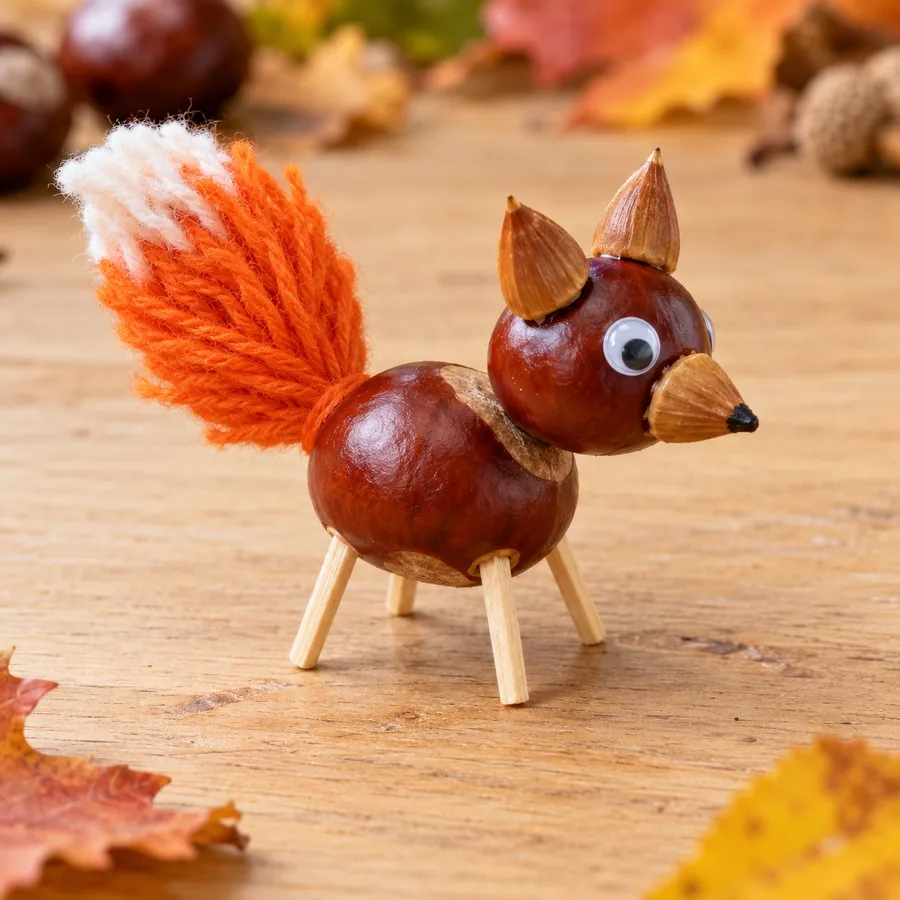
Chestnut fox on matchstick legs with beechnut ears and snout and a tail of orange yarn

Fox

A pointy snout, pointy ears and a bushy tail of orange yarn.

Materials

  • 2 chestnuts
  • 1 toothpick
  • 4 matchsticks (without heads)
  • 3 beechnuts (two as ears, one as the snout)
  • Yarn (orange and white)
  • 1 googly eye
  • 1 felt-tip pen

Tools

Awl or hand drill, Craft glue, Scissors

  1. Stand the bigger chestnut on four matchstick legs as the body.
  2. Push the smaller chestnut onto half a toothpick as the head and glue on a beechnut, point forward, as the snout.
  3. Glue two beechnuts on top of the head as pointy ears.
  4. Bundle several orange strands of yarn, knot them in the middle, and color the end white or add a white piece.
  5. Glue the bundle of yarn into a hole at the back and fluff it up a little.
  6. Stick on a googly eye and paint the tip of the beechnut snout black as the nose.

More ideas: chestnut animals and beyond

Once the first figures are standing, the same moves take you further. A few ideas, sorted by difficulty:

  • Very easy: a caterpillar made of several chestnuts, a snail with a chestnut shell, a chestnut necklace, a ladybug
  • On four legs: horse, dachshund, piglet, sheep, elephant, giraffe, deer
  • People: a chestnut woman in a paper skirt, a gnome, a king, a pirate, a witch with a broom
  • For the more experienced: dragon, unicorn, robot, sailboat, race car, chestnut train
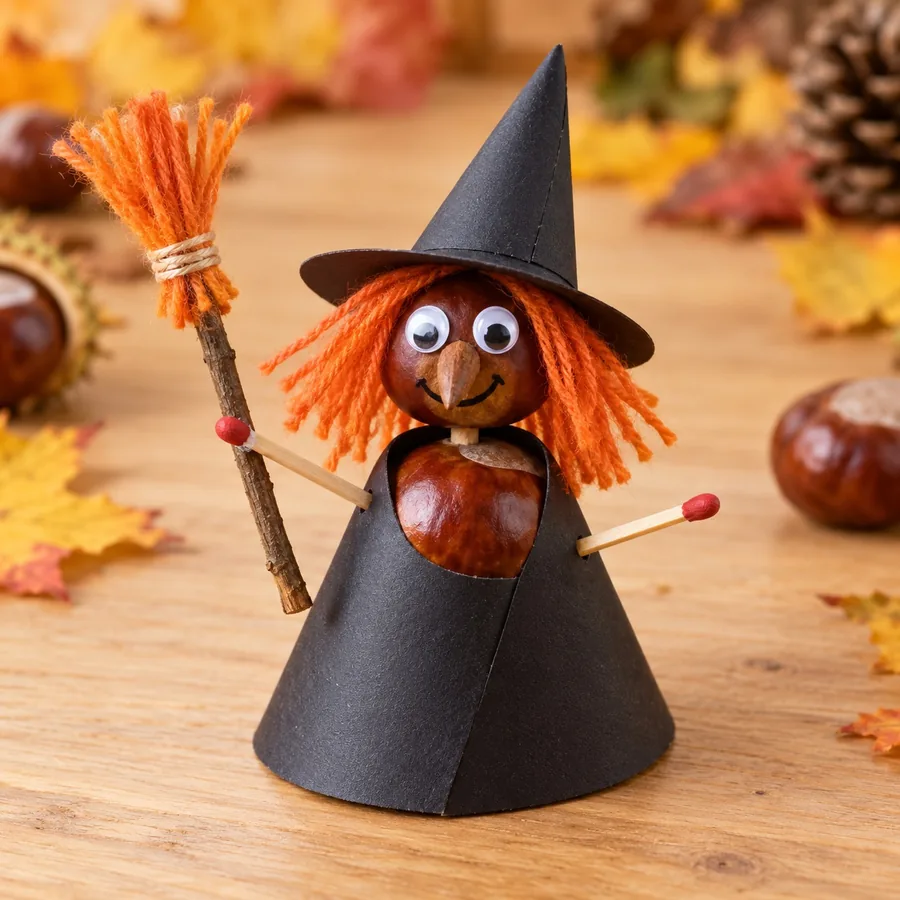
Chestnut witch with a pointed hat, orange yarn hair, a broom and a black construction-paper skirt Exploded view of the chestnut owl with numbered parts

The witch stands in a construction-paper skirt; next to her, the owl in parts. Sample images, AI-generated.

How long do chestnut figures last?

A few weeks. Chestnuts dry out over time, wrinkle and shrink a little. That loosens toothpicks and matchsticks, and the figure gets wobbly. A drop of glue in each hole keeps it together longer.

Store chestnuts you are not using right away in a basket or an open bowl with plenty of air, not in a plastic bag, where they get damp and go moldy.
Kastelli app icon

The matching app

51 chestnut figures with Kastelli

The four figures above come from Kastelli, a craft app for iPhone. It has 51 chestnut figures, from hedgehog and owl to witch, dragon and race car.

  • A materials list with quantities and the tools you need for every figure
  • An exploded view with numbered parts and a picture of every step
  • Supplies checklist and shopping list: see which figures you can make right away
  • Ten figures without a purchase, all others with a one-time purchase

App Store: coming soon

More about Kastelli

Frequent questions

When is the best time to collect chestnuts?

In the Northern Hemisphere, horse chestnuts fall from mid-September to mid-October; in the Southern Hemisphere, roughly from March to April. Freshly fallen chestnuts with a shiny shell work best.

How do you make holes in chestnuts?

With an awl, a hand drill or a thin nail, about a quarter to half an inch deep. Fresh chestnuts are the easiest to drill. Rest the chestnut on a cloth or a lump of modeling clay so it does not roll away.

What age can kids make chestnut figures?

Putting parts together, gluing and painting works from preschool age if an adult pre-drills the holes. Children under three should not craft with chestnuts, acorns and googly eyes, because they can swallow small parts.

Are horse chestnuts poisonous?

Horse chestnuts are not edible and can cause stomach pain and nausea if eaten raw. Handling them for crafts is fine. Keep an eye on small children and wash hands afterwards.

How long do chestnut figures last?

A few weeks. Chestnuts dry out over time, shrink a little and wrinkle, so toothpicks and matchsticks come loose. A drop of glue in each hole keeps the figure together longer.